


AI is already part of how GEODI works, with capabilities woven throughout the platform.
We use it to understand documents, describe what we need to find across millions of items, and interpret, classify, or have a conversation with the data we discover.
AI is becoming an integral part of GEODI.
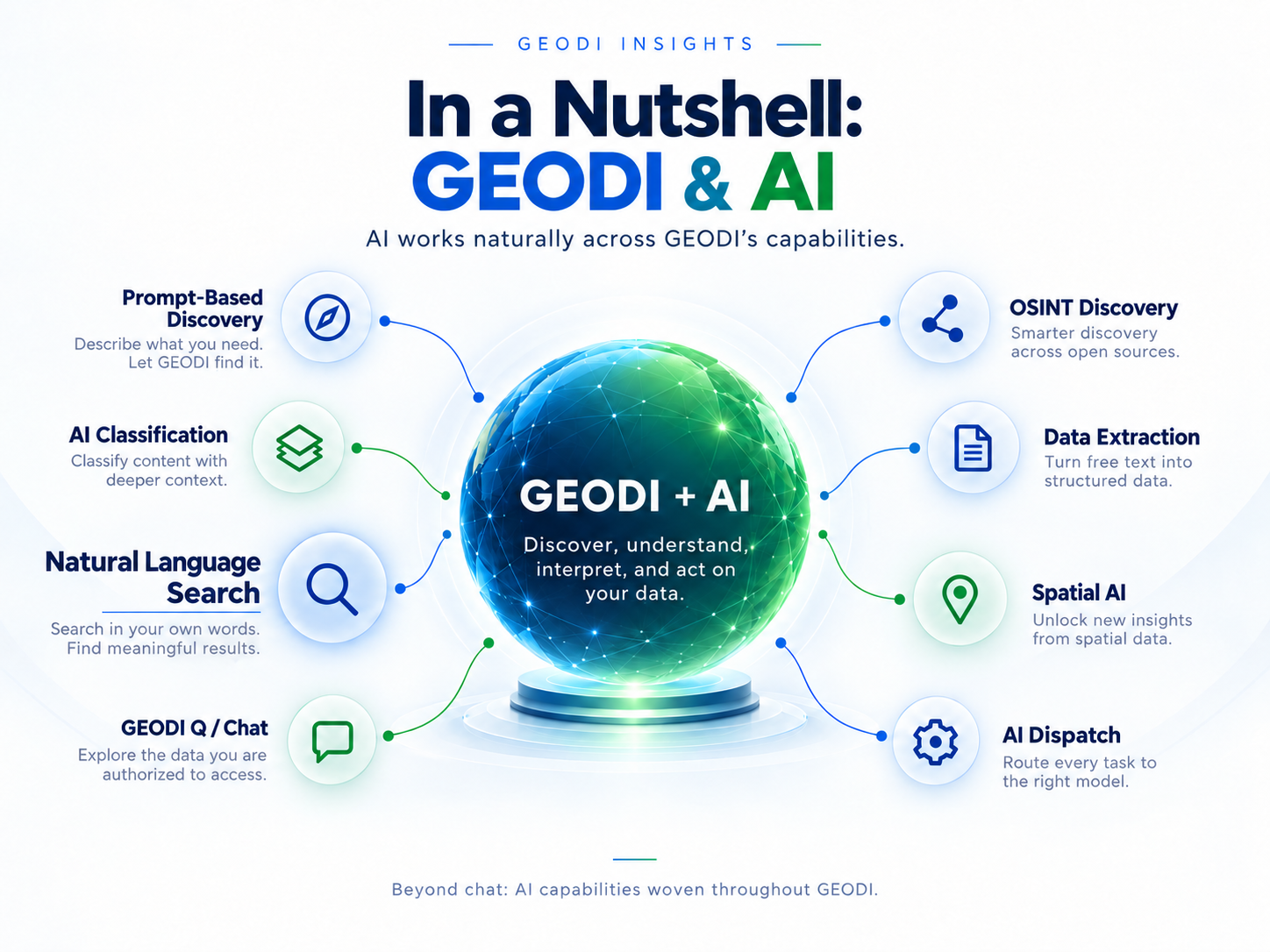
The capabilities featured in the visual show just how far AI reaches across GEODI today:
Prompt-Based Discovery, AI Classification, Natural Language Search, GEODI Q / Chat, OSINT Discovery, Data Extraction, Spatial AI, and AI Dispatch.
You don’t always need to know the right keyword, regular expression, or recognizer.
With Prompt-Based Discovery, you describe what you’re looking for:
“Find correspondence containing customer complaints and refund requests.”
“Find content suggesting that an employee intends to leave the company.”
“Identify potential personal data breaches in these documents.”
GEODI turns that description into a discovery query. You can run it again, apply it to new content, and compare results over time.
A prompt becomes a discovery query that keeps working.
GEODI has been finding, indexing, connecting, and classifying content for years.
AI adds another layer: meaning.
AI Classification assesses what content is about and the context it belongs to. It works alongside existing recognizers and rules, strengthening GEODI’s established capabilities.
A deeper understanding of your data.
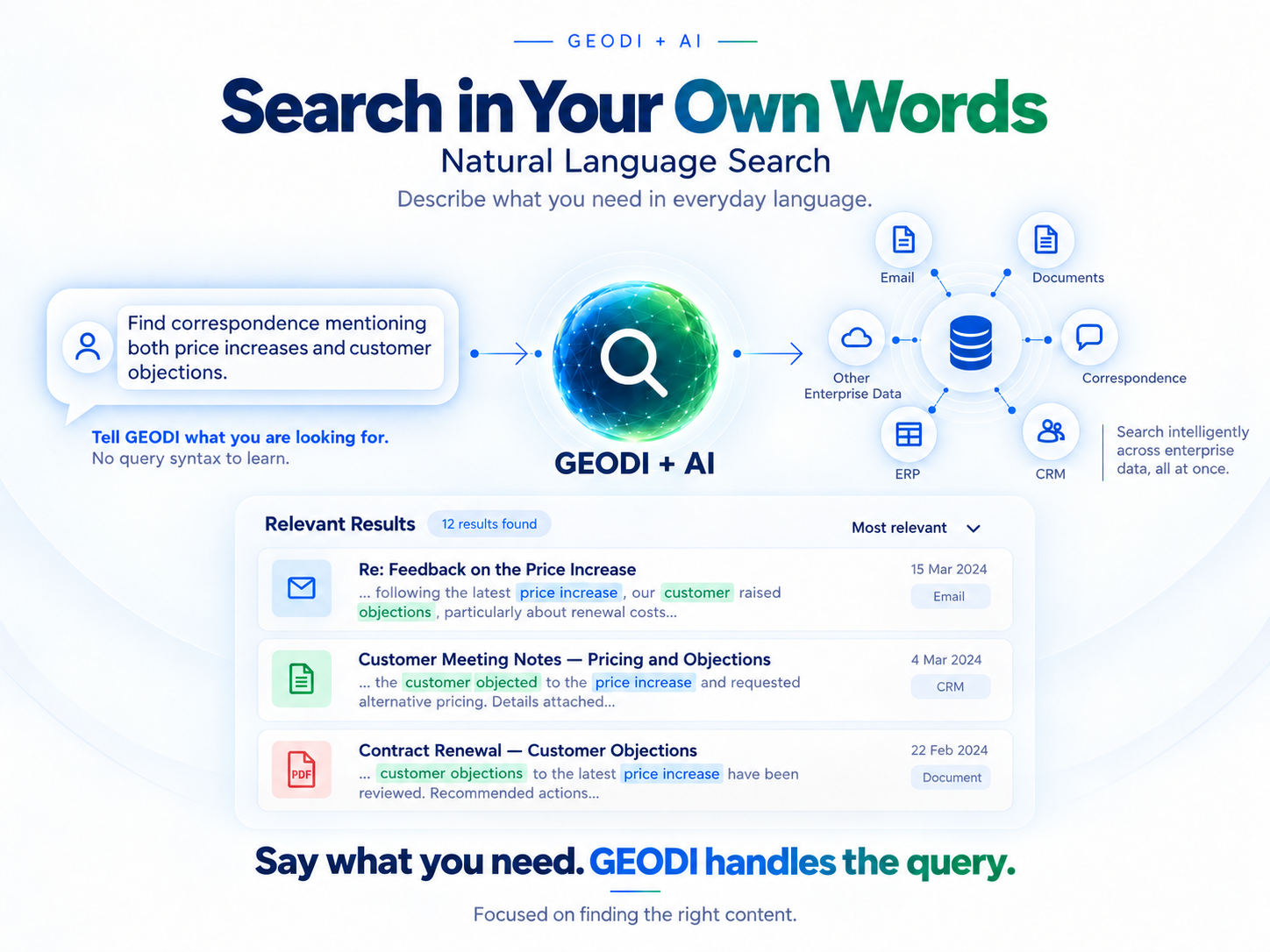
You don’t need to learn a complex query language to search.
Simply describe what you need:
“Find correspondence that mentions both price increases and customer objections.”
GEODI interprets your request and finds relevant results across emails, documents, correspondence, CRM, ERP, and other enterprise data sources.
Chat generates answers about a topic. Natural Language Search focuses on finding the right content.
Say what you need. GEODI handles the query.
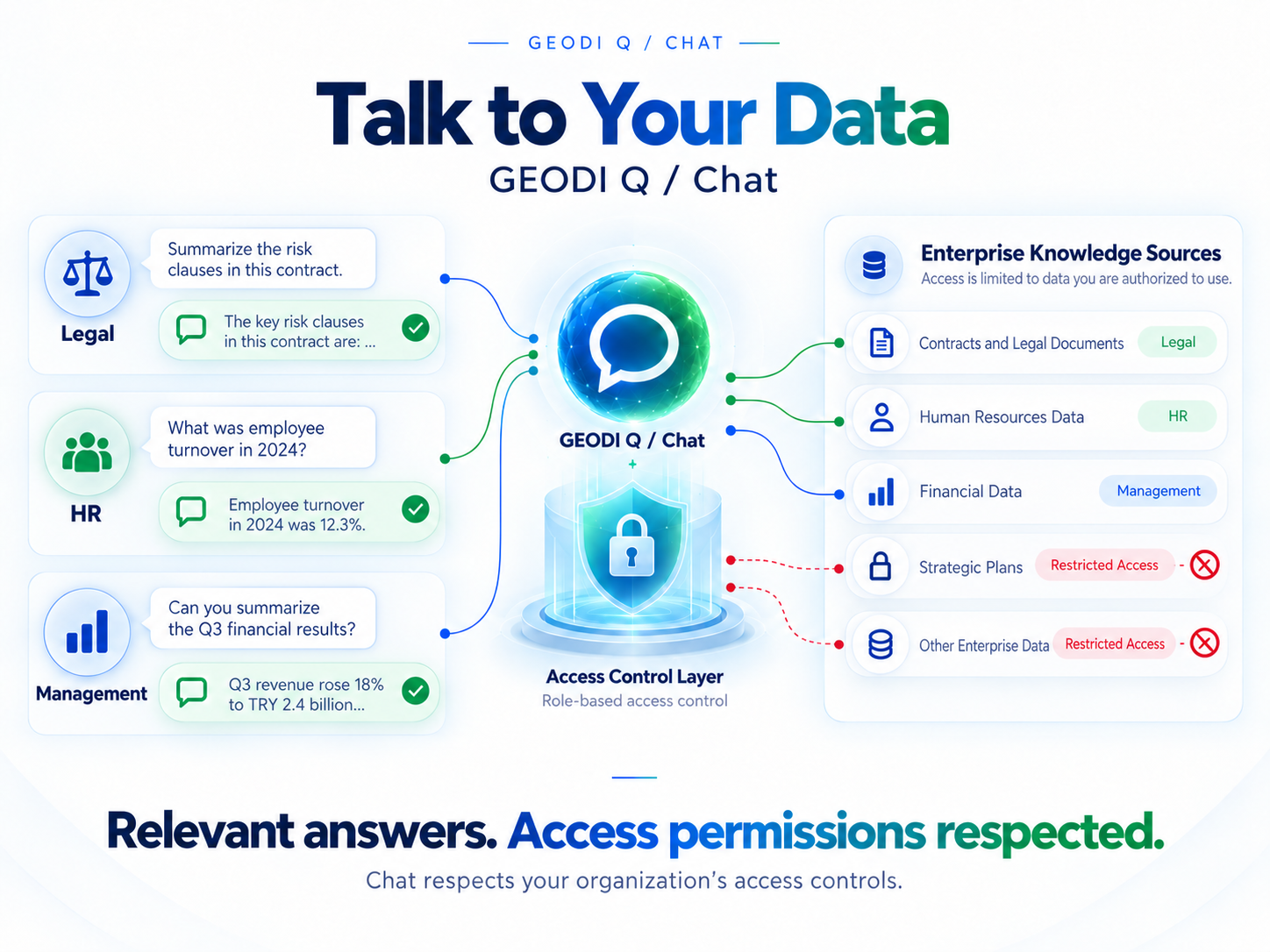
GEODI Q lets you have a natural-language conversation with your enterprise data, within your organization’s existing access permissions.
Legal teams ask questions about contracts. HR works with its own data. Management queries the financial and business information it is authorized to access.
Asking the right question does not unlock information a user is not allowed to see.
When generating answers, GEODI Q respects the user’s access permissions and the scope of the data available to them.
For example, if strategic plans or other restricted information fall outside a user’s permissions, Chat does not use that information to generate an answer.
Relevant answers. Access permissions respected.
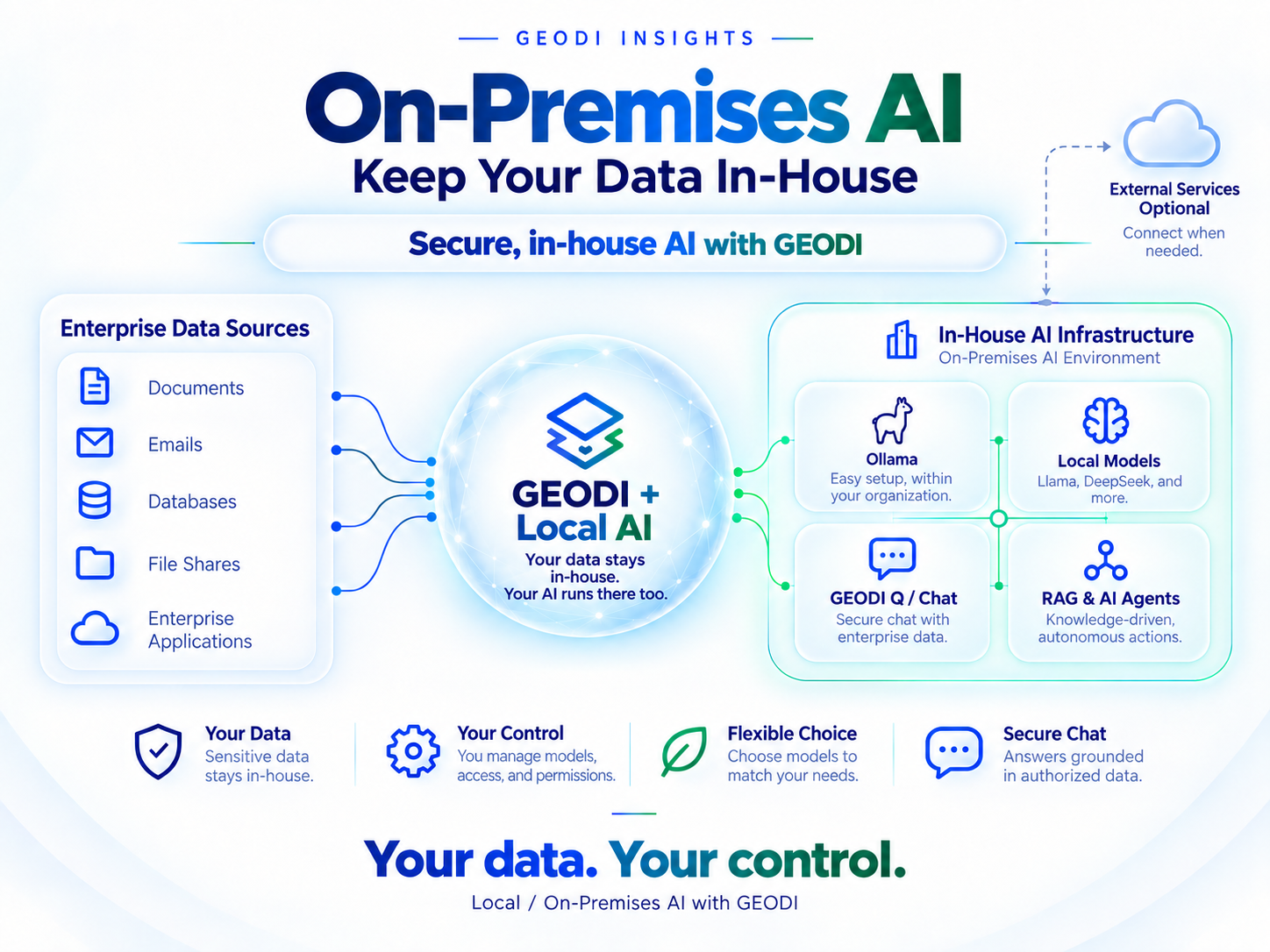
Using AI doesn’t have to mean sending enterprise data to an external service.
GEODI works with local AI infrastructure across internal documents, emails, databases, file shares, and enterprise applications.
Through Ollama, models such as Llama and DeepSeek can run within your organization.
GEODI Q / Chat, RAG, and AI agent scenarios can use this same internal AI infrastructure.
External services are optional. Choose a local or cloud model to suit your needs.
Your data stays in-house. Your AI runs there too.
Your data. Your control.
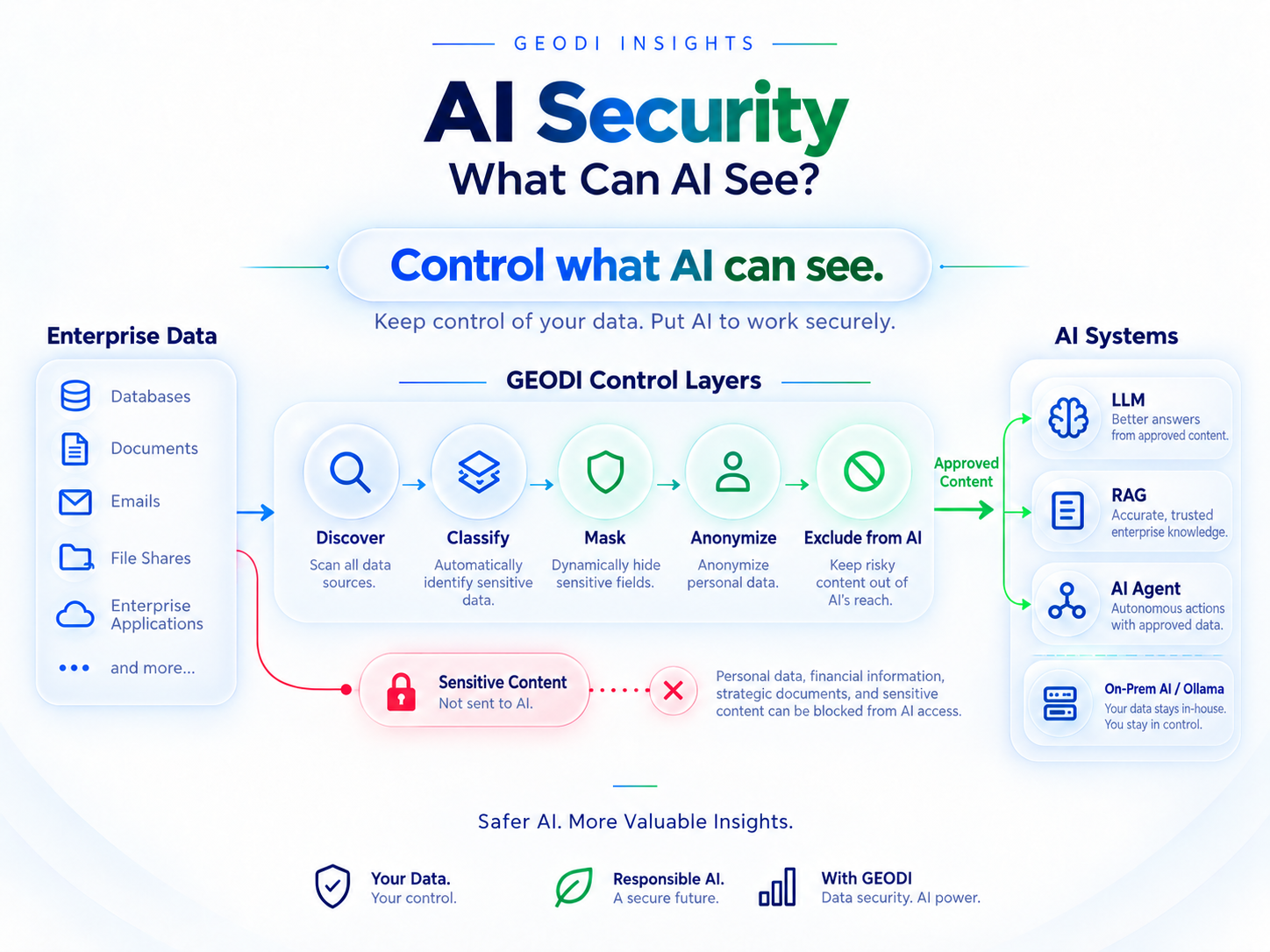
AI security goes beyond protecting models and prompts.
One of the most fundamental questions is:
Which enterprise data can AI access?
GEODI provides a control layer between enterprise data and AI systems.
Data from databases, documents, emails, file shares, and other enterprise sources is first discovered and classified.
Where necessary, sensitive fields are masked, personal data is anonymized, or content is excluded from AI access altogether.
Only then is the approved content passed to LLMs, RAG systems, or AI agents.
Control begins before the data reaches AI.
GEODI’s approach to AI Security is simple:
Control what AI can see.
AI in GEODI extends far beyond a chat window.
Prompt-Based Discovery lets you describe what you want to find.
AI Classification makes sense of content.
Natural Language Search lets you search in your own words.
GEODI Q lets you talk to enterprise data.
OSINT Discovery evaluates open-source information.
Data Extraction turns free text into structured data.
Spatial AI uncovers new meaning in spatial data.
AI builds naturally on these capabilities across the platform.
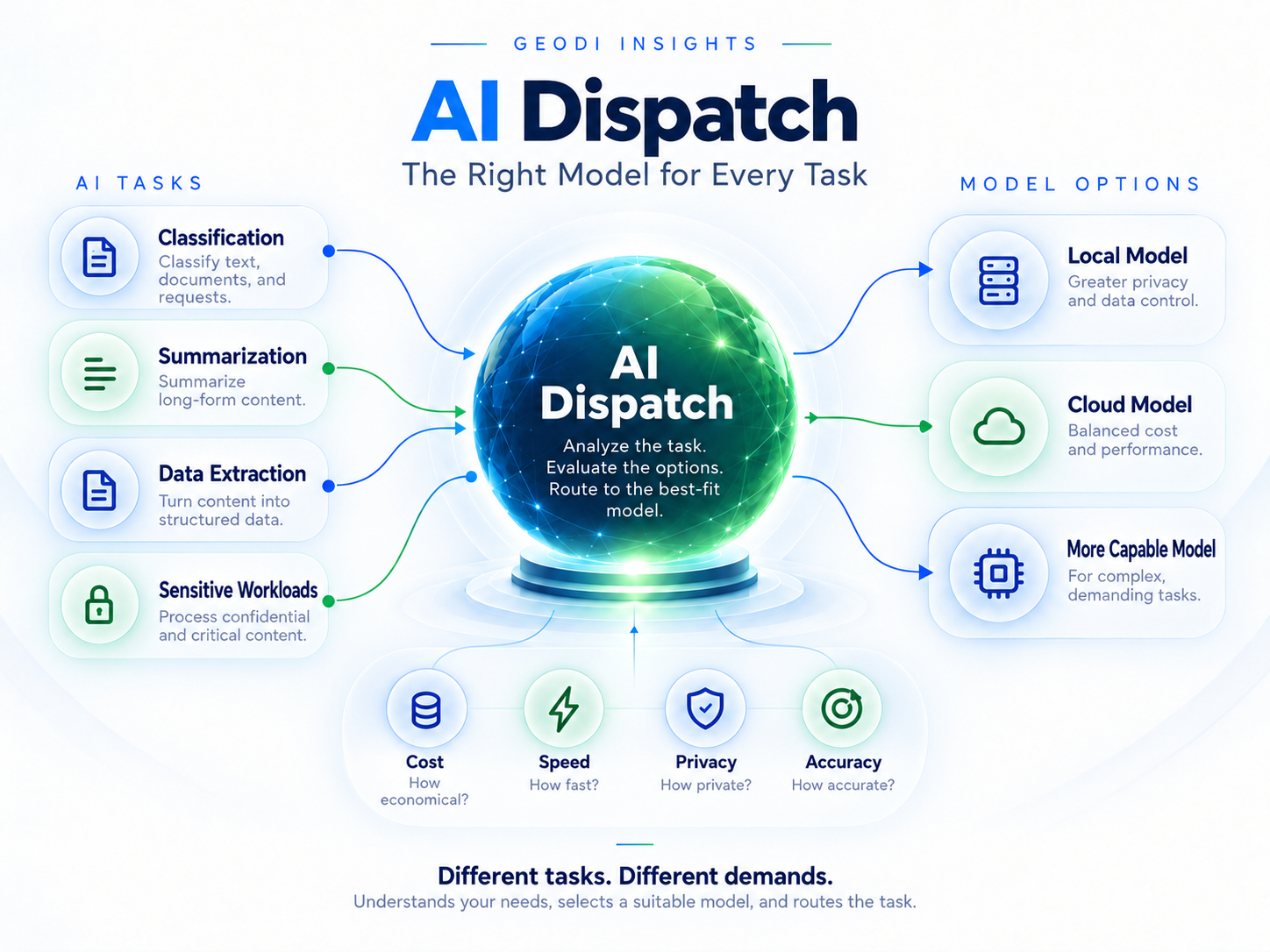
Different AI tasks have different requirements.
Classifying text, summarizing a long document, structuring data, and analyzing a sensitive workload each call for a different approach.
The same model won’t be the best fit for every task.
AI Dispatch evaluates the work and routes it to a suitable model based on cost, speed, privacy, and accuracy requirements.
One task runs on a local model.
Another uses a cloud model.
A more demanding task is routed to a more capable model.
Different tasks. Different demands.
The right model for every task.
At first glance, these capabilities might look like separate products, technologies, and projects.
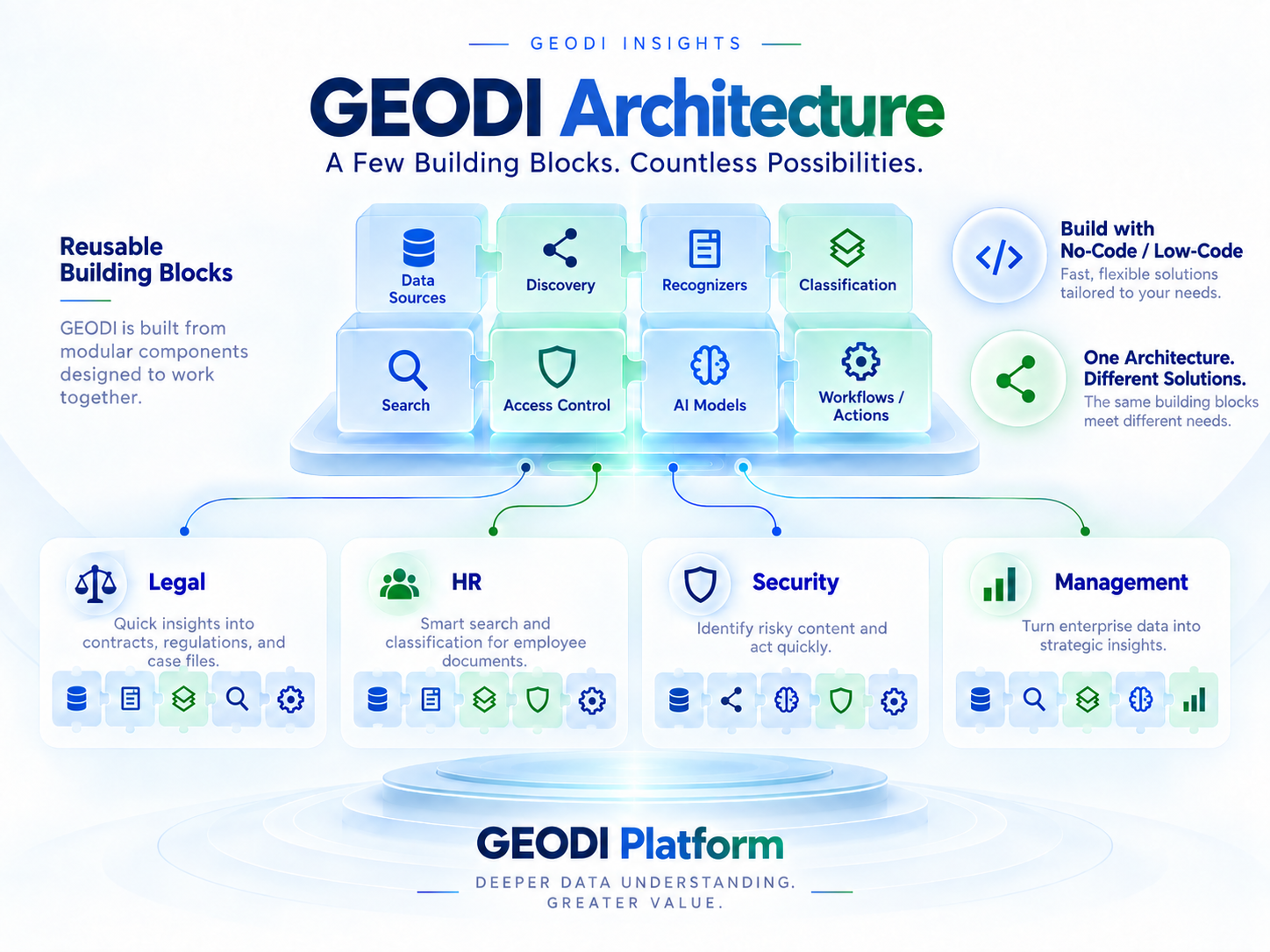
Think of GEODI’s architecture as a set of LEGO-like building blocks:
Data Sources + Discovery + Recognizers + Classification + Search + Access Permissions + AI Models + Workflows / Actions
Different combinations create different solutions.
Legal teams can work with contracts and case files.
HR can search and classify employee documents.
Security teams can identify risky content and take action.
Management can generate summaries and insights from enterprise data.
All of these solutions share the same underlying architecture.
The same GEODI building blocks, combined in different ways.
Choose a data source. Define a recognizer or prompt. Add Search, Classification, or AI. Set access permissions. Use a workflow to take action.
Much of this can be built using GEODI’s no-code / low-code capabilities.
A new business need doesn’t always require a new software project.
A few building blocks. Countless possibilities.
One architecture. Different solutions.
Today, almost everyone has access to an LLM.
Saying “we use AI” is no longer much of a differentiator on its own.
GEODI’s advantage comes from the capabilities it already had before AI entered the picture.
It connects to dozens of data sources, reads hundreds of formats, discovers and classifies content, links information, enforces access permissions, and takes action when needed.
AI creates real value when it builds on that foundation.
AI brings GEODI’s years of data understanding into everyday use.
Large organizations also have more than one AI need.
Legal, HR, management, security, and operations each face different challenges.
With GEODI, each team can start with its own problem.
Teams use their own data, permissions, prompts, models, and workflows on the same GEODI architecture.
Solve a problem. Create value. Expand where it makes sense.
The direction is clear:
GEODI is becoming a platform where you spend less time figuring out which menu or query to use, and more time simply saying what you want to achieve.
That is the purpose of this newsletter: to encourage everyone using, building on, or presenting GEODI to ask one question more often:
“How can AI make this more intuitive, faster, or smarter?”



.png)


