


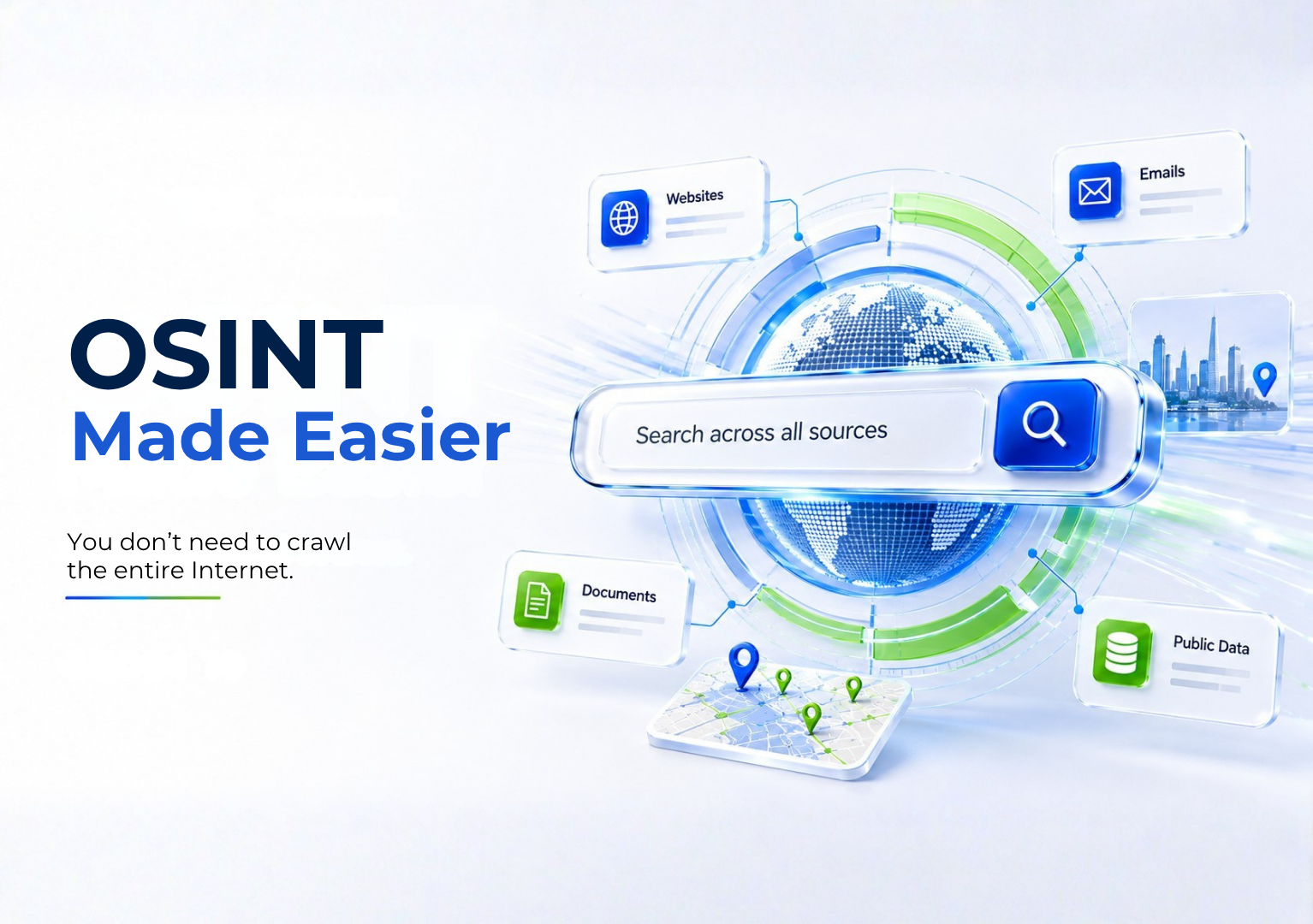
For years, enterprise discovery has focused on information stored inside the organization.
File servers.
Cloud repositories.
Databases.
Emails.
Collaboration platforms.
But today, valuable information is no longer confined to enterprise systems.
The Internet has become one of the world's largest information repositories—containing websites, public documents, product catalogs, research papers, technical documentation, forums, source code, procurement notices, public cloud storage, and countless other information sources.
The challenge is no longer accessing information.
The challenge is discovering the right information.
Open Source Intelligence (OSINT) is the process of discovering, collecting, and analyzing information from publicly available sources.
While OSINT is often associated with cybersecurity, its applications extend far beyond security.
Organizations use OSINT for:
Ultimately, OSINT transforms publicly available information into actionable knowledge.
GEODI has always been designed around a simple principle:
Information should be discoverable regardless of where it resides.
Until now, that meant repositories such as:
With GEODI 10, that philosophy naturally extends to the Internet.
Public websites and Internet-accessible information become just another discovery source that can be searched, classified, analyzed, and correlated with enterprise data.
For GEODI, the Internet is simply another repository.
Traditional web crawling starts with URLs.
Traditional search starts with keywords.
GEODI starts with intent.
Instead of asking:
Which website should I search?
Users simply ask:
Discovery becomes driven by business questions—not predefined locations.
OSINT extends discovery into completely new business domains.
Monitor counterfeit products, unauthorized distributors, and fake websites using your company's brand.
Discover websites promoting unauthorized medicines, medical devices, or healthcare products.
Track product launches, public documentation, technical whitepapers, pricing information, and competitor announcements.
Continuously discover newly published regulations, standards, tenders, public consultations, and government announcements.
Collect publicly available information about suppliers, distributors, and business partners before making strategic decisions.
Search procurement opportunities, technical specifications, public contracts, and tender documentation.
Explore publications, patents, conference papers, standards, and emerging technologies.
Support investigations by discovering publicly available information related to counterfeit goods, illegal software distribution, intellectual property violations, fake online stores, phishing campaigns, or other suspicious online activities.
These are only a few examples.
Every organization has its own discovery questions.
Perhaps the most exciting evolution is Prompt-Based Discovery.
Instead of defining repositories, URLs, or complex search rules, users simply describe what they want to discover.
For example:
Find websites offering counterfeit versions of our products.
Discover public documents discussing lithium battery recycling.
Locate websites advertising unauthorized pharmaceuticals.
Find procurement documents related to railway modernization.
Search for technical documentation about industrial automation published during the last year.
The focus shifts from where to search to what to discover.
GEODI translates intent into discovery.
The real value of OSINT begins after discovery.
Once information is collected, it immediately becomes part of the GEODI Discovery platform.
Organizations can:
The Internet is no longer isolated from enterprise discovery.
It becomes part of the same information ecosystem.
Enterprise discovery continues to evolve.
Yesterday, organizations searched file servers.
Today, they search cloud platforms, collaboration systems, databases, and enterprise repositories.
Tomorrow, the Internet will simply be another place where discovery happens.
OSINT is not replacing enterprise discovery.
It is expanding it.
Because the most valuable information isn't always stored inside your organization.
Sometimes, it's already waiting to be discovered.



.png)


